
Emergency Roof Repair Near Me: What Santa Ana Homeowners Should Do First
If you have water coming through your ceiling in Santa Ana right now, start by containing the water inside, documenting the damage with photos, and covering the roof penetration with a tarp only if you can reach it without getting on a wet or steep surface. Then call your insurance carrier and a licensed roofing contractor, in that order. If you’d rather not handle any of that on your own, call Tilecraft Roofing at (833) 467-4846 and we’ll walk you through the first hour while we head your way.
Here’s the part most homeowners don’t realize until they’ve lived through it: the 90 minutes after a roof is damaged determine whether you’re looking at a $600 tarp job or a $14,000 interior remediation claim. In a Santa Ana wind event, water doesn’t need a visible hole to enter your home. A lifted section of flashing open for four hours during a storm can push enough moisture into a wall cavity to trigger mold within 48 hours. We pulled a section of ridge cap out of a lemon tree on Flower Street after a January windstorm last year. The homeowner had no visible ceiling damage. The moisture meter in the wall cavity said otherwise.
Key Takeaways
- Document before you touch anything. Photos of the exterior, the interior water path, and any displaced roofing material are your insurance claim’s foundation.
- Contain water at the floor level, not the ceiling level. A bucket on wet drywall becomes a ceiling collapse.
- Call insurance before the contractor. Most policies require prompt notification, and the carrier may have a preferred tarping vendor.
- A tarp secured incorrectly in Santa Ana’s wind is a second damage event waiting to happen.
- Contractors who appear within 60 minutes of a storm deserve more scrutiny, not less.
The First Hour: A Checklist That Prevents a $14,000 Ceiling
The first hour after you notice a roof leak in Santa Ana is about three things: safety, documentation, and containment. In that order. Everything else can wait.
First, look up. If the ceiling is sagging, water is pooling in the drywall above you. Do not stand under it. Do not poke it with a broom handle. A water-logged ceiling section can release without warning, and the wet drywall alone can weigh more than you’d want landing on a couch or a dining table. Move anything of value out from under the bulge and place a plastic bin below the lowest point of the sag. Not directly under it. Offset the bin slightly so when the ceiling gives, the weight doesn’t hit you while you’re repositioning a bucket.
Second, document. Use your phone. Photos of the exterior damage from the ground, photos of the interior water path, photos of any shingles, tiles, or flashing you can see displaced. Wide shots first, then close-ups. Your insurance adjuster will ask for exactly these. The photos you take in the first 20 minutes are often the clearest evidence you’ll have, because rain keeps moving through the structure and changing the picture.
Third, contain at the floor. Place towels or a folded moving blanket over your flooring in the path of the drip. Water staining on Santa Ana homes with older oak or engineered hardwood is a separate claim item many homeowners forget to prevent. If water is running down an interior wall, pull furniture away from that wall by at least two feet. You’re buying time, not fixing anything.
Fourth, locate the source from inside if you can. Attic access in Santa Ana ranches is usually a pull-down in a hallway ceiling. If you can safely get your head into the attic, shine a light along the underside of the roof deck. You’re looking for the highest wet spot, because water runs downhill. The entry point is often four to six feet uphill from where the water shows up on your ceiling. This information saves the contractor 30 minutes and saves you labor hours on the repair invoice.
Insurance First, Contractor Second: Why the Order Matters
Most homeowners in Santa Ana call a roofer first, then their insurance company. We understand the instinct. You want the water stopped. But the order should be reversed, and here’s why: your homeowner’s policy has a duty-to-mitigate clause that requires you to take reasonable steps to prevent further damage. Calling a licensed contractor to tarp the roof is reasonable. What’s also true is that your carrier may have a preferred emergency mitigation vendor who will tarp at pre-negotiated rates. If you sign a repair authorization with the first contractor who knocks on your door before your claim is even opened, you may have committed to pricing your adjuster won’t honor.
Here’s the sequence we recommend to every Santa Ana homeowner who calls us mid-emergency:
- Document everything, as described above.
- Call your insurance carrier’s claims line. Many have 24-hour emergency reporting. Give them the photos, the timeline, and the visible damage. Ask whether they have a preferred tarping or mitigation vendor.
- Ask whether your policy covers emergency tarping as a separate mitigation line item. Most do. It keeps the emergency repair from eating into your replacement deductible.
- Then call a licensed roofing contractor. Tilecraft Roofing does tarping and temporary weatherproofing as part of our Roof Repair in Santa Ana service, and we’ll work directly with your adjuster if that’s the path.
One caution: if your insurance company’s preferred vendor can’t get to you for 48 hours, don’t wait. A roof left open in Santa Ana’s marine layer is a mold problem by day three. Get a licensed local contractor out, pay the tarping invoice, and submit it to your claim. Reimbursement for reasonable mitigation is standard language in most California homeowners policies.
Tarping in Santa Ana Wind: What Bad Tarping Looks Like
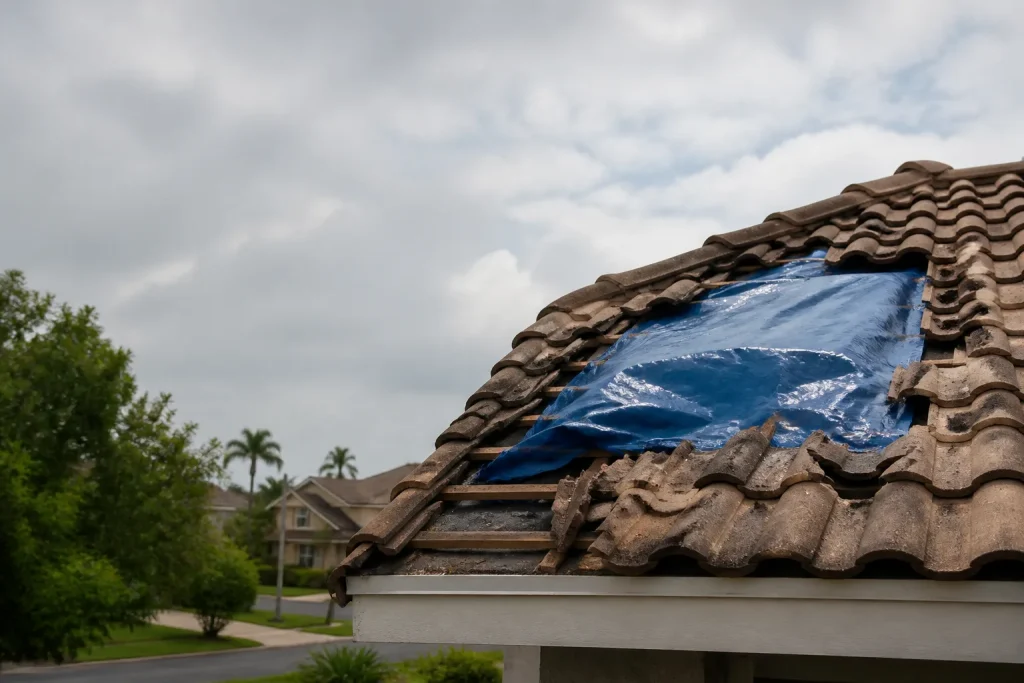
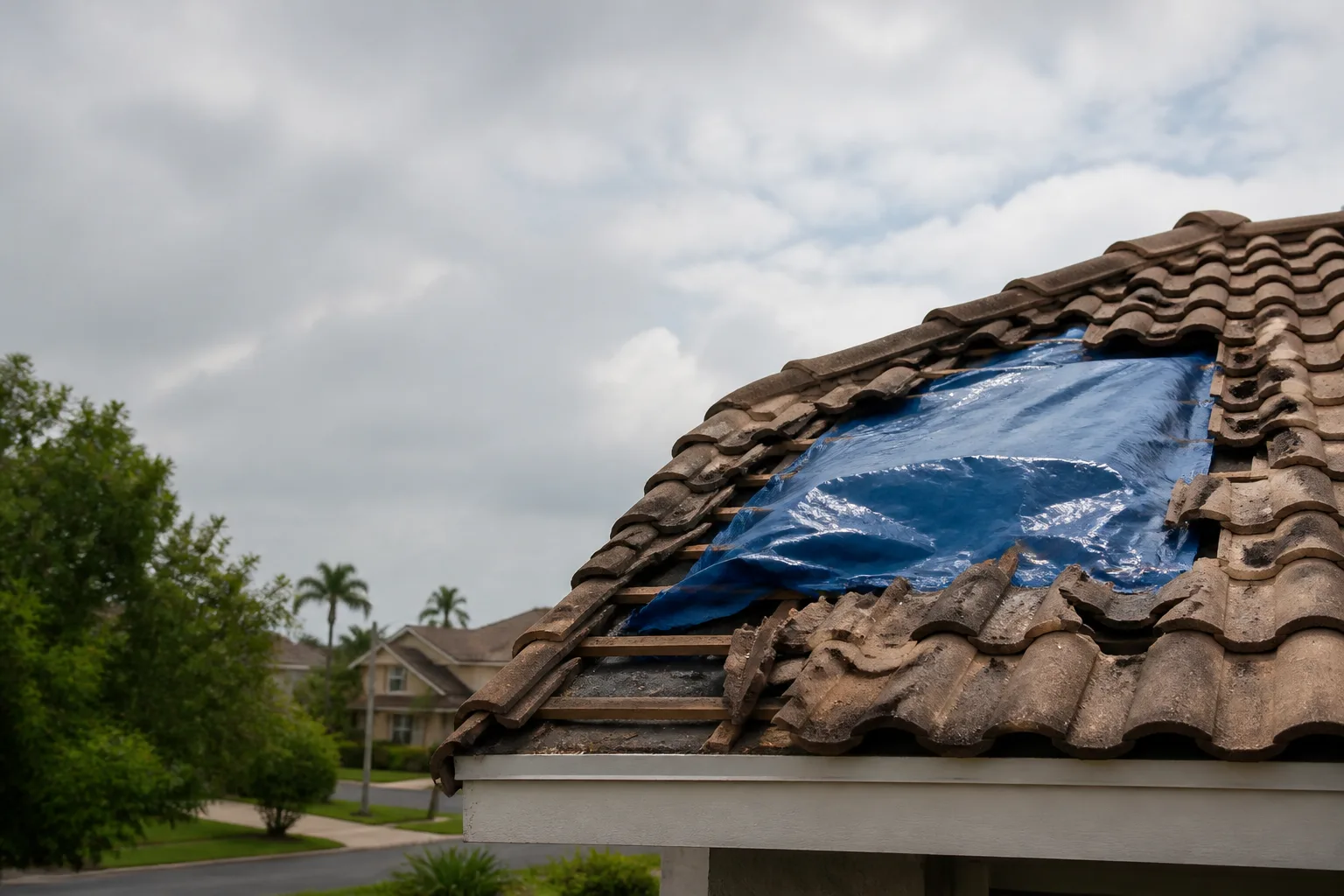
Not all tarping is equal. An improperly secured tarp in a Santa Ana wind event does not just fail to protect your roof. It becomes a sail that rips more shingles off, slaps against the roof deck, and doubles the damage. We’ve repaired roofs where a “storm response” crew tarped with bungee cords and left the scene. The wind got under the leading edge, tore the grommets out, and the tarp ended up wrapped around a neighbor’s chimney.
A properly secured roof tarp covers the damaged section and extends at least four feet past the perimeter of the damage on every side. The leading edge, the one facing the prevailing wind, gets anchored first and most aggressively. In Santa Ana, where the marine layer means moisture is present even when the rain has stopped, the tarp should be secured with cap nails and wood furring strips around the full perimeter, not just corners. The furring strips distribute tension across the tarp instead of concentrating it at grommets, which are the first point of failure.
If a contractor shows up and proposes tarping with ropes tied to fascia boards or anchored to gutters, send them away. That tarp won’t survive the next breeze, and your gutter may not survive the tarp. If the roof is tile, like the Boral systems we work on throughout Santa Ana’s historic Floral Park and Wilshire Square neighborhoods, tarping requires a different approach entirely. You don’t nail through tile. The tarp gets anchored at eaves and rakes, and the damaged tiles are either removed and replaced with spares or sealed until the permanent repair.
When a 60-Minute Response Time Is a Warning Sign
Every storm in Southern California brings a wave of out-of-area roofing crews into Santa Ana. You’ll see trucks with out-of-county plates, magnetic door signs that look newly printed, and door hangers appearing on every house on your block by morning. A contractor who knocks on your door uninvited within an hour of a storm saying they “happened to be in the area” deserves more scrutiny, not less.
Established local roofers in Santa Ana are busy after a storm, yes. But they’re busy with their existing customers, scheduled projects, and warranty callbacks. The idea that a quality contractor is idle enough to canvas a damaged neighborhood 60 minutes after the weather clears does not hold up.
Here are the questions to ask any contractor who appears at your door in the aftermath of a Santa Ana wind or rain event:
- Are you licensed in California, and can I see your license number? (Every legitimate contractor carries this. Every single one.)
- What is your physical business address in Santa Ana or Orange County?
- Do you have workers’ compensation insurance for your crew? Ask to see the certificate.
- How many roof repairs have you completed in Santa Ana in the past two years? Can you provide local references?
- What manufacturer products are you authorized to install? (A contractor who can’t name their manufacturer partnerships is a broker, not a roofer.)
Tilecraft Roofing works with seven roofing manufacturers: GAF, CertainTeed, Owens Corning, IKO, Atlas, Tamko, and Boral. That’s not a brag about selection. It means when we look at your damaged roof, we’re matching the repair to what’s already on your roof, not what we happen to stock in the truck. A storm-chaser with one pallet of bargain shingles is going to tell you that’s the right product. We’d rather tell you the truth.
California Contractor Law: What You Can Be Asked to Sign at the Door
Emergency situations are where California’s contractor laws get tested, and where unscrupulous operators count on you not knowing your rights. Here’s what the law says, in plain terms.
Any contractor performing work over $500 in California must have a valid license from the Contractors State License Board and must provide a written contract. For emergency work, the state allows a contractor to begin work before signing a full written contract under certain narrow conditions, but they still must provide the contract within a reasonable time and you still retain your three-day right to cancel for most home improvement contracts, including those signed at your door.
What’s legally unenforceable in a stress situation:
- Any contract clause that waives your right to cancel within three business days for work solicited at your home.
- Any requirement that you pay the full contract amount up front before work begins. California caps down payments at 10% or $1,000, whichever is less, for home improvement contracts.
- Any oral agreement with no written follow-up. If the contractor won’t put it in writing, the agreement doesn’t exist in the eyes of the state.
- Any clause that says the contractor isn’t responsible for pulling required permits. Roof repairs in Santa Ana that involve structural changes or significant re-roofing sections require permits, and the contractor’s license obligates them to handle that.
The right contractor in an emergency will give you a simple scope-of-work document on the spot: what’s damaged, what the temporary fix is, what the permanent repair will require, and a clear price for each. That’s what we do. The temporary tarp or wrap gets priced separately from the permanent repair, so you can submit the mitigation piece to insurance cleanly. If someone hands you a one-page contract that bundles “emergency services” with a full replacement without any inspection, that’s a red flag. A real roofer looks before they quote.
How to Read a Roof Like an Inspector: What We Look For After a Santa Ana Storm
When we arrive at a storm-damaged roof in Santa Ana, we’re not just looking at the obvious missing shingle. We’re reading the whole roof the way a diagnostic technician reads a panel. Here’s what we check, in order, and what each finding means for you.
First, the perimeter. Fascia, drip edge, and gutters take the first hit in wind events. A loose drip edge is an entry point for wind-driven rain even when the shingles above look intact. In older Santa Ana homes with wood fascia, we look for soft spots where water has been getting behind the paint for years. That’s a repair conversation that extends beyond the storm.
Second, the penetrations. Pipes, vents, skylights, chimneys. These are the most common leak sources we see after Santa Ana rain events, and they have nothing to do with the shingles themselves. The flashing around a pipe boot cracks with age and UV exposure. A chimney with degraded mortar lets water run down the flue and into the attic. These are repair items, not replacement items. We fix a lot of these for a few hundred dollars when a less scrupulous contractor would have quoted a full re-roof.
Third, the field. Missing shingles, lifted edges, granule loss, impact marks from flying debris. This is where the material conversation matters. If your home has architectural shingles from GAF or Atlas, the repair product needs to match the original profile and, ideally, the manufacturer. Mixing shingle types on a Santa Ana roof is not just an aesthetic issue. It can affect how the courses lay and how the warranty applies.
Fourth, the underlayment. This is the layer you can’t see. On Santa Ana homes with older roofs, failed underlayment is why water shows up in places far from any visible shingle damage. We identify this through attic inspection, looking for water staining on the decking between rafters.
If the damage is limited and the underlayment is sound, we recommend Roof Repair in Santa Ana. If the damage exposes widespread underlayment failure or the roof is near the end of its service life, we’ll talk about Roof Replacement in Santa Ana. The decision comes from the inspection, not from a sales quota.
Scheduling the Inspection That Prevents the Next Emergency
Most of the emergency calls we take in Santa Ana are not from homeowners who had a surprise. They’re from homeowners who knew something was off and waited. A small water stain on the bedroom ceiling in September becomes a collapsed section of drywall in February. A missing shingle noticed in March becomes a leak in the holiday season.
A roof inspection in Santa Ana is a standalone service with us. It’s not a sales appointment wearing a lab coat. We inspect, we document what we find, and we give you a written report you can use however you want. If the roof needs nothing, we say so. If it needs a small repair, we’ll quote the repair. If replacement is the honest answer, we’ll walk you through why and give you material options from seven manufacturers.
The Bottom Line
The first 90 minutes after a roof is damaged in Santa Ana are about documentation, containment, and making smart decisions under pressure. Photograph everything before you touch anything. Get water into bins on the floor, not buckets hanging from wet drywall. Call your insurance carrier before you sign anything. And hire a licensed local contractor who reads the whole roof, not just the visible hole.
If you’re in Santa Ana and dealing with a roof that just got hit, call Tilecraft Roofing at (833) 467-4846. We’ll talk you through your first hour, get someone out to assess the damage, and give you a straight answer on what it costs to fix. Estimates are free, and you’ll never get a replacement pitch when a repair is the right call.
Written by the team at Tilecraft Roofing, serving Santa Ana since 2012.
Frequently Asked Questions
Emergency tarping and temporary weatherproofing in Santa Ana typically runs $350 to $800 depending on the size of the damage and whether the roof is tile or shingle. Permanent repairs range from $250 for a small flashing fix to $2,500 or more for structural or underlayment work. The variables are material type, roof pitch, and the extent of the water intrusion. Call (833) 467-4846 for a written estimate after an inspection.
Most Santa Ana homeowners policies cover emergency mitigation, including tarping, as a separate line item from your main repair or replacement claim. The tarping cost is typically reimbursable under the policy’s reasonable-mitigation language, but you must notify your carrier promptly. Document everything before and after the tarp goes on, and keep the contractor’s invoice separate from any permanent repair work.
In Santa Ana’s climate, the answer is not long. The marine layer keeps moisture present even when it isn’t raining, and an exposed roof deck can begin growing mold within 48 to 72 hours. If rain is in the forecast, the timeline shortens to hours. A temporary tarp or weatherproofing should be installed the same day the damage is discovered, or the next day at the latest.
Generally, no. Established roofing contractors in Santa Ana are busy with existing customers after a storm, not canvassing damaged neighborhoods. Any door knocker should be checked against the California Contractors State License Board, asked for a physical Santa Ana business address, and required to provide proof of workers’ compensation insurance. Legitimate contractors expect these questions.
Need Roofing Help?
Call Tilecraft Roofing — licensed & insured, here with fast after-hours help in Santa Ana.
(833) 467-4846